

 Facebook
 X
X
 Pinterest
 Copy Link
Why Miami, Coral Gables and South Florida are becoming much more than a real estate market
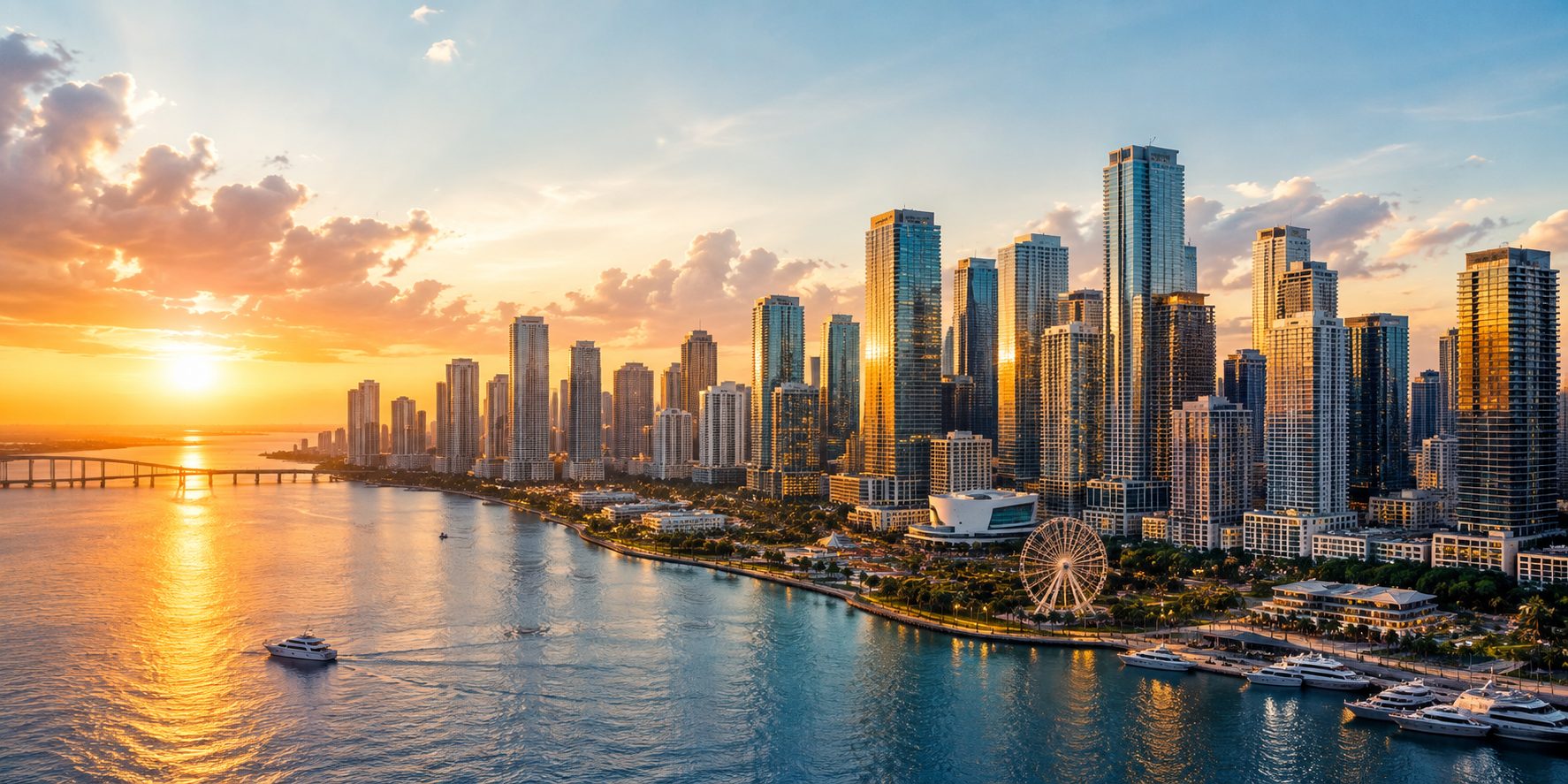
There was a time when people came to Miami primarily for the weather, the beaches and the lifestyle.
Today, something much bigger is happening.
Miami and South Florida are evolving into an international ecosystem where real estate, finance, architecture, hospitality, technology and global wealth increasingly intersect.
And the latest numbers suggest that this transformation is far from over.
1. MIAMI IS STILL GROWING — BUT THE MARKET IS BECOMING MORE SELECTIVE
The most recent Miami-Dade numbers tell an interesting story.
In June 2026, total residential sales increased 14.3% year-over-year, reaching 2,107 transactions — the strongest June since 2023.
Single-family sales increased 16.8%, while condominium sales rose almost 12%.
But perhaps the most significant number is at the upper end of the market: sales of properties priced at $1 million and above increased 29.1% year-over-year.
At the same time, total active inventory in Miami-Dade fell approximately 14.9% from the previous year.
This creates an unusual market.
Miami is not simply experiencing another speculative boom. Buyers have more information, financing remains relatively expensive, and properties must increasingly justify their asking prices.
The result is a market that rewards quality, location and scarcity.

2. CORAL GABLES: SCARCITY MAY BECOME ITS GREATEST LUXURY 🌳
Downtown Miami and Brickell can continue building vertically.
Coral Gables is different.
Its identity is defined by Mediterranean architecture, mature landscaping, established residential neighborhoods, limited waterfront opportunities and a development philosophy that is considerably more controlled.
That scarcity matters.
Recent South Florida market data showed particularly strong price performance in high-tier single-family markets, with Coral Gables among the standout submarkets.
But the long-term attraction of Coral Gables goes beyond a single year of appreciation.
Its value proposition is difficult to reproduce.
You can construct another luxury tower.
You cannot easily recreate decades-old tree canopies, historic neighborhoods, waterfront estates, proximity to Miami’s business centers, excellent schools, established restaurants and the distinctive urban character of Coral Gables.
As Miami becomes denser, I believe places that combine privacy, identity and proximity will become increasingly valuable.
Scarcity itself becomes an amenity.
3. SOUTH MIAMI AND SOUTHERN MIAMI-DADE DESERVE MORE ATTENTION
The next chapter of South Florida will not be written exclusively in Brickell.
As central Miami becomes more expensive and dense, buyers and families increasingly evaluate communities farther south.
South Miami, Pinecrest, Palmetto Bay, Cutler Bay and parts of southern Miami-Dade offer something increasingly difficult to find near major global cities:
space without complete disconnection from the urban core.
That distinction is important.
The future of South Florida real estate will likely become increasingly segmented.
Some buyers will continue choosing vertical luxury: branded residences, waterfront condominiums and highly serviced buildings.
Others will prioritize land, privacy, schools, outdoor living and neighborhood quality.
For that second group, the communities south of Miami’s urban core could become increasingly strategic.
This is particularly relevant as single-family inventory tightens. Miami-Dade had approximately 4.9 months of single-family supply in June, a level generally associated with a seller’s market.
Meanwhile, existing condominiums had approximately 12.3 months of supply, creating considerably more negotiating power for buyers.
In other words, there isn’t really one “Miami market.”
There are multiple markets operating simultaneously.
4. FOLLOW THE MONEY — MIAMI IS BECOMING AN INTERNATIONAL CAPITAL 🌎
One of the most important forces shaping South Florida is not architecture.
It is capital.
Foreign buyers purchased approximately $4.4 billion of South Florida residential real estate in 2025, up from $3.1 billion the previous year.
Approximately 51% of international transactions were all-cash.
And Miami-Dade captured roughly 73% of South Florida’s foreign buyers.
International demand is also extraordinarily diversified, coming from Latin America, Canada, Europe, Asia and the Middle East.
Italy is part of that story as well, representing approximately 4% of Miami-Dade’s international buyers in 2025.
Even more revealing is what is happening in new construction.
International buyers accounted for approximately 49% of new construction, pre-construction and condo-conversion sales measured across a major sample of South Florida projects.
That tells us something fundamental:
Miami real estate is increasingly being evaluated not merely against Orlando, Tampa or other American cities.
It is competing for capital with New York, London, Dubai, Madrid and other international destinations.
5. THE ECONOMY BEHIND THE REAL ESTATE IS CHANGING TOO
Buildings alone don’t create sustainable real estate value.
Economic activity does.
Miami’s office market provides another piece of the puzzle.
During Q2 2026, the market recorded approximately 344,000 square feet of positive net absorption, while average asking rents reached about $68.60 per square foot. Around 1.3 million square feet of office space remained under construction.
At the same time, Florida continues to attract international migration. U.S. Census estimates show that Florida recorded the largest net international migration of any state in 2025, while Miami-Dade was among the U.S. counties receiving the largest international inflows.
This combination matters.
Companies bring executives.
Executives need homes.
Employees need housing.
Restaurants, schools, professional services, hospitality and retail follow population and wealth.
And infrastructure eventually follows all of them.
Real estate is often the physical expression of those economic movements.
6. THE NEXT MIAMI MAY BE ABOUT QUALITY, NOT JUST QUANTITY
For investors, homeowners and international buyers, I believe the most interesting question is no longer simply:
“Will Miami continue to grow?”
A better question may be:
“Where will the next phase of value be created?”
The answer could be very different depending on the objective.
For some, it may be a waterfront condominium in Miami.
For others, a single-family residence in Coral Gables or Pinecrest.
For an investor, it could mean identifying neighborhoods benefiting from infrastructure, demographic movement and limited future supply.
And for international buyers, understanding the differences between neighborhoods, property types, insurance costs, condominium financials, taxation and ownership structures is becoming increasingly important.
South Florida is maturing.
And mature markets reward selectivity.
After more than a decade living and working in Miami, one thing continues to fascinate me: this city rarely stands still.
It reinvents itself.
And perhaps that is ultimately Miami’s greatest real estate asset.
As an Italian living and working in South Florida, I also see this transformation from two perspectives.
I have the privilege of helping create a bridge between Italy and the United States, assisting international clients who want to understand not only where to purchase property, but how Miami and South Florida are evolving as places to live, invest and build their future.
🇮🇹 Italy ↔ United States 🇺🇸
Sometimes the best investment begins long before choosing a property.
It begins by understanding where a city is going next.
What area of South Florida do you believe has the greatest potential over the next five years — Miami, Coral Gables, South Miami, Pinecrest, or somewhere else?

Salvatore Domina REALTOR® | Coldwell Banker Realty Coral Gables – Miami International Real Estate | Italy & USA
